Opennms First Look: Unboxing and Impressions
Network management has evolved from a luxury for large-scale enterprises into a fundamental necessity for organizations of all sizes. As infrastructure becomes increasingly distributed across hybrid clouds, edge locations, and traditional on-premises data centers, the tools used to monitor these assets must be robust, scalable, and highly adaptable. OpenNMS (Open Network Management System) occupies a unique position in this landscape. As one of the world’s first enterprise-grade open-source network management platforms, it offers a level of depth that often surprises those accustomed to lightweight, commercial "plug-and-play" solutions. This first look explores the initial experience of deploying OpenNMS, examines its architectural strengths, and provides a detailed analysis of its capabilities for the modern electronics and networking professional.
When approaching a platform like OpenNMS, it is important to understand that this is not a simple utility software. It is a comprehensive framework designed to handle millions of events per day and manage hundreds of thousands of nodes. For the systems administrator or network engineer, the "unboxing" of OpenNMS is more about the discovery of its modular architecture and the breadth of its data collection capabilities. Unlike proprietary solutions that often hide their inner workings behind restrictive licenses and silos, OpenNMS provides a transparent view into the health of the network, offering deep integration with existing workflows and third-party tools.
The Architecture of Enterprise Monitoring
The first impression one gets when initializing OpenNMS is the sheer scale of its internal engine. The platform is built on a modular, event-driven architecture that prioritizes reliability and performance. At its core, OpenNMS functions through four primary pillars: event management, provisioning, service monitoring, and performance data collection. During the setup phase, it becomes clear that the software is designed to be highly automated. The provisioning system, for instance, uses "Provisioning Groups" to define how the system should interact with different classes of hardware, whether they are core routers, virtual servers, or IoT devices at the edge.
One of the most impressive technical aspects encountered during the first look is the "Horizon" vs. "Meridian" distinction. OpenNMS Horizon is the community-driven version, frequently updated with the latest features and experimental integrations, making it ideal for tech-savvy teams who want to stay on the cutting edge. OpenNMS Meridian is the stable, long-term support version aimed at production environments where uptime is the only metric that matters. This dual-track approach ensures that the platform can serve both as a Playground for innovation and a bedrock for enterprise stability.
Detailed Product Analysis and Use Cases
In real-world applications, buyers and IT managers care about three main things: visibility, scalability, and actionable intelligence. OpenNMS addresses visibility through its extensive support for various protocols. While many tools are limited to basic SNMP (Simple Network Management Protocol), OpenNMS extends its reach into JMX, HTTP, JDBC, and even custom scripts. This means a single dashboard can monitor the health of a database, the latency of a web application, and the physical temperature of a rack-mounted switch simultaneously.
Scalability is perhaps where OpenNMS shines brightest. The introduction of "Minion" nodes—distributed monitoring agents—allows the platform to monitor remote locations without requiring complex VPN tunnels for every single packet. These Minions collect data locally and securely forward it back to the central server. For a global electronics manufacturing firm with facilities in multiple continents, this distributed architecture is a game-changer. It reduces the load on the central site and ensures that even if a WAN link goes down, the local monitoring remains active, buffering data until connectivity is restored.
Actionable intelligence is provided through a sophisticated event correlation engine. Many monitoring tools suffer from "alert fatigue," where a single failed switch triggers hundreds of individual notifications for every device connected to it. OpenNMS uses advanced topology discovery and event reduction logic to identify the root cause. Instead of alerting for every lost server, it can identify that the upstream router is the point of failure, significantly reducing the Mean Time to Repair (MTTR).
Functional Strengths and Challenges
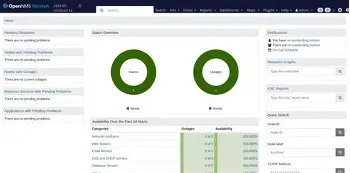
Implementing OpenNMS requires a shift in mindset. It is a powerful engine that demands a degree of expertise to tune correctly. However, once the initial configuration is complete, the level of detail available is staggering. The user interface provides various views, from high-level geographic maps showing the status of global offices to granular "KSC" (Keep Statistics Clean) reports that visualize long-term performance trends. The integration with Grafana further enhances this, allowing teams to create beautiful, data-rich dashboards that can be displayed in Network Operations Centers (NOCs).
Looking for the best Electronics deals on Amazon?
See Deals →Pros and Cons
- Pro: Massive Scalability. Capable of handling hundreds of thousands of nodes with a distributed architecture that grows with your needs.
- Pro: Open Source Freedom. No per-node licensing fees, which provides significant cost savings as the network expands.
- Pro: Protocol Support. Beyond SNMP, it supports an exhaustive list of monitors including XML, JSON, and synthetic transactions.
- Pro: Event Correlation. Reduces noise by grouping related events and identifying root causes through topology awareness.
- Pro: Active Community. High-quality documentation and a dedicated user base provide a wealth of knowledge and custom integrations.
- Con: Steep Learning Curve. The configuration can be daunting for beginners, often requiring knowledge of XML and Linux systems administration.
- Con: Resource Intensive. To run at scale, OpenNMS requires a significant amount of RAM and high-performance storage for its database.
- Con: UI Complexity. The traditional web interface is functional but can feel overwhelming due to the sheer number of options and menus.
Comparison with Industry Standards
To better understand OpenNMS's position in the market, it is helpful to compare it against other common monitoring paradigms. While many tools focus on a specific niche, OpenNMS attempts to be the "everything" platform for network data.
| Feature | OpenNMS (Horizon/Meridian) | Traditional SaaS Monitors | Basic Open-Source Tools |
|---|---|---|---|
| Primary License | Open Source (GPL) | Proprietary / Subscription | Open Source / Varies |
| Scalability | Enterprise (100k+ nodes) | High (Limited by cost) | Small to Medium |
| Data Retention | Virtually Unlimited (Local/S3) | Limited by Plan | Varies |
| Customization | Extensive (Scriptable) | Limited to Provided APIs | Moderate |
| Support | Community & Paid Commercial | Included Enterprise Support | Community Only |
Buying Guide: Is OpenNMS Right for You?
Choosing a network management system is a long-term commitment. When evaluating OpenNMS, potential adopters should consider several factors relative to their specific environment. This guide outlines the criteria that typically define a successful implementation.
Identify Your Scale
If you are managing a small office with twenty devices, OpenNMS might be overkill. The setup time and resource requirements may outweigh the benefits. However, if you are managing a service provider network, a university campus, or a large corporation with multiple branches, the scalability of OpenNMS makes it one of the few viable options that won't break the budget on licensing fees.
Assess Technical Resources
OpenNMS is "administrator-friendly" but not necessarily "casual-user-friendly." A successful deployment usually requires at least one team member who is comfortable with Linux environments, PostgreSQL databases, and XML configuration. Organizations that prefer a "set it and forget it" GUI-only experience might find the initial learning curve frustrating, while those who love to "look under the hood" will find it empowering.
Evaluate Integration Needs
Buyers should look at their existing stack. Do you use Jira for ticketing? Grafana for visualization? Elasticsearch for logs? OpenNMS integrates exceptionally well with these. One of the strongest use cases for OpenNMS is as the central "collector" that feeds high-quality network data into other business intelligence tools. If your goal is to build a unified monitoring ecosystem, OpenNMS is an excellent foundational component.
Cost of Ownership vs. Licensing
While the software itself is free, the Total Cost of Ownership (TCO) includes hardware and personnel time. For many, the ability to reallocate "license money" toward "engineering talent" or "better hardware" is the primary driver for choosing OpenNMS. It allows an organization to own its data and its monitoring destiny without being subject to the price hikes or feature deprecations of a commercial vendor.
A Deep Dive into Management Features
Beyond basic monitoring, OpenNMS offers sophisticated features like "Business Service Monitoring" (BSM). BSM allows administrators to map technical assets to actual business functions. For example, instead of just seeing that a server is down, the dashboard can show that the "Email Service" is at 50% capacity or that the "Payroll System" is at risk. This translation layer is critical for communicating with stakeholders who care more about service availability than individual switch port status.
Looking for the best Electronics deals on Amazon?
See Deals →The platform also includes a robust reporting engine. Many electronics companies must adhere to strict Service Level Agreements (SLAs) with their customers. OpenNMS can automatically generate uptime reports, latency histograms, and availability statistics. This data is not just useful for internal troubleshooting; it serves as a record of performance that can be used to prove compliance with contractual obligations.
Furthermore, the "Newts" (New Time Series) project integrated within OpenNMS allows it to handle modern metrics at an incredible velocity. Traditional RRD (Round Robin Database) storage can sometimes hit a wall when dealing with high-frequency data from thousands of sources. Newts is designed to sit on top of Apache Cassandra, providing a storage back-end that can scale horizontally across a cluster of servers. This makes OpenNMS one of the few platforms capable of true "High Metrics" monitoring in the era of IoT and 5G.
Customization and Extensibility
The "First Look" experience also reveals the extensibility of the platform. Because the source code is open, and the API is comprehensive, developers can create custom "Poller Plugins." If a company develops a proprietary piece of hardware that communicates over a unique protocol, they can write a Java-based plugin for OpenNMS to monitor that device natively. This level of customization is often impossible with "boxed" commercial software, where you are limited to what the vendor chooses to support.
Inventory management is another often-overlooked feature. OpenNMS doesn't just monitor if a device is up; it performs deep discovery of physical components. It can track serial numbers, hardware revisions, and firmware versions across the entire network. For an electronics-focused enterprise, this provides an automated asset inventory that is invaluable during audit cycles or hardware refresh projects. Knowing exactly which switches are running a vulnerable version of firmware—and being able to generate a report in seconds—is a major security and operational boon.
Conclusion
OpenNMS is a formidable tool that represents the best of enterprise open-source software. It provides a level of depth, scalability, and transparency that is rare in the electronics and networking industry. While the initial "unboxing" reveals a complex system with a significant learning curve, the rewards for mastering it are substantial. It empowers organizations to move away from restrictive per-node licensing models and toward a more flexible, data-driven approach to infrastructure management.
For the modern network professional, the impressions left by OpenNMS are those of power and potential. It is a system that grows with the organization, capable of monitoring everything from a simple sensor to a global mesh of data centers. Its focus on event correlation, distributed monitoring, and high-velocity data storage ensures its relevance in an increasingly connected world. For those willing to invest the time in setup and configuration, OpenNMS offers a comprehensive window into the digital heartbeat of the enterprise, making it a definitive leader in the realm of open network management.